THIS IS OUR PROJECT ..
HE SEEMED A "WIKIPEDIA", BUT ONLY CONTAINS INFORMATION OF BRASILIA.
JUST REGISTER THERE'S NEXT >>
AND ALSO YOU CAN BE PART OF THIS!

sexta-feira, 18 de julho de 2014

WHERE TO GO OUT IN BRASILIA?
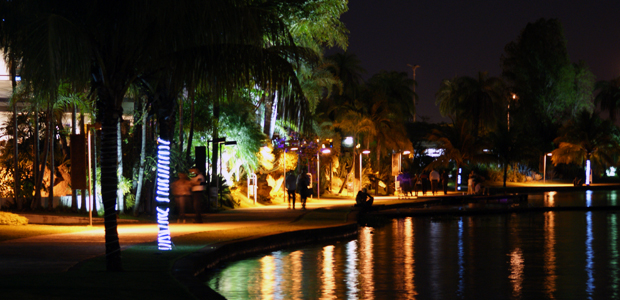
There are diametrically opposed opinions when it comes to nightlife in Brasília. Some will say it’s the “capital or boredom”, while others will strongly defend the city by saying that it has everything you need to experience an unforgettable night, just like in Rio de Janeiro, São Paulo or other places. The truth is, Brasília like every other town has its own climate, and we should explore it ourselves without wasting time on comparing it to other cities. Indeed, it might sometimes seem a bit calm, but if you search well, you will surely find something suitable for you.

Where to go out in Brasília? As it’s a city visited by lots of important people, it offers wide range of exclusive upscale Brasília restaurants and pubs, many of which can be found in Asa Sul district. The city haven’t forgotten though about its inhabitants and other visitors, who are concentrated on spending nice time, not necessarily correlating it with excessive budget spending.

The capital hosts many bars where you can meet for two-dollar chopp (draught beer) and chat with local students and young artists (e.g. bars close to UnB – Universidade de Brasília). Of course there are as well plenty of places with pretty elevated prices and more fancy climate, like the ones in Asa Sul neighborhood. No need to mention, that of course there is also a “middle” in classification of bars, clubs and restaurants in Brasília. Try going along Via W Três Sul and Via Ers, and you will surely find something that suits you.
For those who are not big fans of bars and parties, there are for example many spots to play snooker. Alternatively, quite often Brasilienses (inhabitants of Brasília), instead of going out to a bar or restaurant, choose cinema. The offer is also quite wide here, from alternative movie theatres up to multiplexes in shopping centers.

As dancing is very important to all Brazilians, the capital couldn’t afford not providing Setor de Clubes (Clubs’ Sector) to cultivate tradition of samba, forró and other Brazilian-style parties. In case you prefer rock, funk, pop or trance, you will find something to entertain yourselves as well.
To sum up, doesn’t matter if you are looking for upscale, middle or downscale restaurants, bars or pubs in Brasília – maybe there will not be as many as in Rio de Janeiro or São Paulo, and maybe they won’t be opened for as long as you wish – but they are there, waiting for you to enjoy them!
Fonte
Food
As Brazil’s youngest city, Brasília doesn’t have its own typical, regional cuisine.
Inhabited and visited by Brazilians from all parts of the country, as well as many international guests, Brasília has one of the best restaurant base in the country. You can find dishes from various regions, with emphasis on the Midwest. Alternatively, there are many excellent places with influences from Italian, French, Arabic, Japanese or Spanish cuisine.

Bacon-wrapped shrimp
Price range varies widely. Part of the food infrastructure targets to host important personalities from political and top-business areas, while many other excellent restaurants and buffets receive less demanding locals and tourists.

Self-service buffets (por quilo) are very common and usually cheaper than regular restaurants.
Many of Brasilia’s food service units are located in residential wings, usually a bus or taxi ride away from tourist attractions. It’s a good idea to do this small trip and enjoy your meal in true Brazilian climate.

Main shopping streets, such as the CLS 405 and CLS 210, concentrate great variety of delicious restaurants. You may just go for a walk there and grab something to eat in one of nearby locations.
fonte


Brasilia to date
 |
| Padlocks on bridge |
 |
| Cine Drive in |
 |
| Lake |
 |
| Lake and the beautiful sky of Brasilia |
 |
| City park |
 |
| City park |
 |
| Lake |
 |
| Lake |
 |
| Pontão |
 |
| Pontão |


WHAT TO DO IN BRASILIA?
 |
| Night in Brasilia |
WHAT TO DO IN BRASÍLIA?
Although the capital of Brazil is only 53 years old, it has a lot to offer for tourists coming here from all around the globe. Apart from the fact that you should see the capital of the country you are visiting, bear in mind that Brasília is a really unique place, built from dust and scrub in only 4 years by workers from Northeast, led by urban planner Lúcio Costa, architect Oscar Niemeyer and landscape engineer Roberto Burle Marx. With its carefully planned structure, modernist buildings and excellent design to the smallest detail, Brasília has replaced Rio de Janeiro as capital of Brazil and quickly joined UNESCO’s list of World Heritage Sites.
Viewed from above, the heart of the city resembles an airplane, bird or a butterfly, divided into numbered blocks as well as sectors for specified activities, such as the Hotel, Banking or Embassy Sector.
The innovative urban planning and daring architecture of Brasília is a very interesting thing to see. Praça dos Três Poderes is a civic landmark which headquarters the most important government authorities and various monuments. You will find here beautiful buildings of Congresso Nacional (Congress), Palácio do Planalto where the President of Brazil is holding her office, Supremo Tribunal Federal (Supreme Federal Court), Panteão and Maquete de Brasília – model which greatly visualizes layout of Brasília and helps you understand the urban plan of the city.
Praça dos Três Poderes is connected to another member of “What to do in Brasília” list – Supremo Esplanada dos Ministérios, where you will find Catedral with replica of famous Michelangelo‘s Pietà, two palaces (Palácio da Justiça and Palácio do Itamaraty), as well as National Museum, Teatro Nacional (Teatro Nacional Cláudio Santoro) and National Library (Biblioteca Nacional) – all three making part of Complexo Cultural da República.
Moving on, along Brasília’s unique architectural landmarks, you should visit Eixo Monumental with Palácio da Alvorada (Presidential Palace), and 75-meter Torre de TV (TV Tower), at the base of which there is Feira da Torre, market-place where you can eat typical Brazilian food and buy handicrafts.
Due to the fact that the region is very dry, an artificial lake has been created, with the objective to increase the humidity in its vicinity. Paranoá Lake (Lago Paranoá) covers area of 48 square kilometers, has maximum depth of 38 meters and some artificial beaches. Around the lake there are several bars and restaurants where you can spend a very pleasant day.
These are just few examples of great variety of sights Brasília offers. If you’re not sure what you want to see, you can take Brasília City Tour bus or watch air photos of the city, and maybe this will give you clearer image of city’s uniqueness.
Visit Attractions
 |
The National Congress Building.
|
At the end of the Eixo Monumental ("Monumental Axis") lies the Esplanada dos Ministérios ("Ministries Esplanade"), an open area in downtown Brasília. The rectangular lawn is surrounded by two eight-lane avenues where many government buildings, monuments and memorials are located.
National Congress
The Palácio da Alvorada.
Brazil's bicameral National Congress consists of the Senate (the upper house) and the Chamber of Deputies of Brazil (the lower house). Since the 1960s, the National Congress has been located in Brasília. As with most official buildings throughout the city, it was designed by Oscar Niemeyer in the style of modern Brazilian architecture. The hemisphere to the left is the seat of the Senate and the hemisphere to the right is the seat of the Chamber of Deputies. The Congress also occupies various other surrounding buildings, some connected by tunnels.
The National Congress building is located in the middle of the Eixo Monumental, the city's main avenue. In front lies a large lawn and reflecting pool. The building faces the Praça dos Três Poderes where the Palácio do Planalto and the Supremo Tribunal Federal are located.
Palácio da Alvorada
The Palácio da Alvorada is the official residence of the President of Brazil. The palace was designed, along with the rest of the city of Brasília, by Oscar Niemeyer and inaugurated in 1958.
One of the first structures built in the republic's new capital city, the "Alvorada" lies on a peninsula at the margins of Lake Paranoá. The principles of simplicity and modernity, that in the past characterized the great works of architecture, motivated Niemeyer. The viewer has an impression of looking at a glass box, softly landed on the ground with the support of thin external columns.
The building has an area of 7,000 m2 with three floors consisting of the basement, landing, and second floor. The auditorium, kitchen, laundry, medical center, and administration offices are at basement level. The rooms used by the presidency for official receptions are on the landing. The second floor has four suites, two apartments, and various private rooms which make up the residential part of the palace.
The building also has a library, a heated Olympic-sized swimming pool, a music room, two dining rooms and various meeting rooms. A chapel and heliport are in adjacent buildings.
The Palácio do Planalto.
The Palácio do Planalto is the official workplace of the President of Brazil. It is located at the Praça dos Três Poderes in Brasília. As the seat of government, the term "O Planalto" is often used as a metonym for the executive branch of government.
The main working office of the President of the Republic is in the Palácio do Planalto. The President and his family do not live in it, rather in the official residence, the Palácio da Alvorada. Besides the President, senior advisors also have offices in the "Planalto," including the Vice-President of Brazil and the Chief of Staff. The other Ministries are along the Esplanada dos Ministérios.
The architect of the Palácio do Planalto was Oscar Niemeyer, creator of most of the important buildings in Brasília. The idea was to project an image of simplicity and modernity using fine lines and waves to compose the columns and exterior structures.
The Palace is four stories high, and has an area of 36,000 m2. Four other adjacent buildings are also part of the complex.
Itamaraty Palace, headquarters of the Ministry of External Relations.
Complexo Cultural da República
The Complexo Cultural da República (Portuguese for Cultural Complex of the Republic) is formed by the National Library of Brasília and the National Museum of the Republic. It is situated in the Eixo Monumental, next to the Cathedral of Brasília.
The National Library of Brasília (Biblioteca Nacional de Brasília in Portuguese) occupies an area of 14,000 m2, consisting of reading and study rooms, auditorium and a collection of over 300,000 items.
The National Museum of the Republic (Museu Nacional da República in Portuguese) consists of a 14,500 m2 exhibit area, two 780-seat auditoriums, and a laboratory. The space is mainly used to display temporary art exhibits.
Paranoá Lake
Paranoá Lake is a large artificial lake built to increase the amount of water available to the region. It has the second largest marina in Brazil, and hosts wakeboarders and windsurfers
Juscelino Kubitschek bridge
The Juscelino Kubitschek bridge, also known as the 'President JK Bridge' or the 'JK Bridge', crosses Lake Paranoá in Brasília. It is named after Juscelino Kubitschek de Oliveira, former president of Brazil. It was designed by architect Alexandre Chan and structural engineer Mário Vila Verde. Chan won the Gustav Lindenthal Medal[30] for this project at the 2003 International Bridge Conference in Pittsburgh due to "...outstanding achievement demonstrating harmony with the environment, aesthetic merit and successful community participation".
It consists of three 60 m (200 ft) tall asymmetrical steel arches that crisscross diagonally. With a length of 1,200 m (0.75 miles), it was completed in 2002 at a cost of US$ 56.8 million. The bridge has a pedestrian walkway and is accessible to bicyclists and skaters.
Praça dos Três Poderes
Supreme Court of Brazil.
Praça dos Três Poderes (Portuguese for Square of the Three Powers) is a plaza in Brasília. The name is derived from the encounter of the three federal branches around the plaza: the Executive, represented by the Palácio do Planalto (presidential office); the Legislative, represented by the National Congress (Congresso Nacional); and the Judicial branch, represented by the Supreme Federal Court (Supremo Tribunal Federal).
It is a tourist attraction in Brasília, designed by Lúcio Costa and Oscar Niemeyer as a place where the three branches would meet harmoniously.
Cathedral of Brasília
The Cathedral of Brasília in the capital of the Federative Republic of Brazil, is an expression of the architect Oscar Niemeyer. This concrete-framed hyperboloid structure, seems with its glass roof reaching up, open, to the heavens. On 31 May 1970, the Cathedral’s structure was finished, and only the 70 m (229.66 ft) diameter of the circular area were visible. Niemeyer's project of Cathedral of Brasília is based in the hyperboloid of revolution which sections are asymmetric. The hyperboloid structure itself is a result of 16 identical assembled concrete columns. These columns, having hyperbolic section and weighing 90 t, represent two hands moving upwards to heaven. The Cathedral was dedicated on 31 May 1970.
Popular culture
Brasília has also been the focus of modern day literature. Published in 2008, The World In Grey: Dom Bosco's Prophecy, by author Ryan J. Lucero, tells an apocalyptic story based on the famous prophecy from the late 19th century by the Italian saint Don Bosco.[31]
According to Don Bosco's prophecy
Between parallels 15 and 20, around a lake which shall be formed; A great civilization will thrive, and that will be the Promised Land.
Brasília lies between the parallels 15° S and 20° S, where an artificial lake (Paranoá Lake) was formed. Don Bosco is Brasília's patron saint.
American Flagg!, the First Comics comic book series created by Howard Chaykin, portrays Brasília as a cosmopolitan world capital of culture and exotic romance. In the series, it is a top vacation and party destination.
FONTE
History
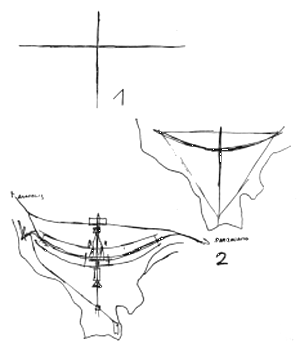
The history of Brasília, the centrally located capital of Brazil, starts with discussions in the eighteenth century. The name Brasília was first proposed in 1822, but construction only began in 1956, following the election of Juscelino Kubitschek as President of Brazil. Its official declaration as a city dates to 21 April 1960, and the process of moving the federal government offices started on that date.

The Juscelino Kubitschek Memorial.
President Juscelino Kubitschek ordered the construction of Brasília, fulfilling an article of the country's constitution dating back to 1891 stating that the capital should be moved from Rio de Janeiro to a place close to the center of the country. The building of the new capital also fulfilled a campaign promise of Kubitschek. The plan was originally conceived in 1827 by José Bonifacio, an advisor to Emperor Pedro I, who presented a plan to the General Assembly for a new city called Brasilia with the initial idea of moving the capital farther westward from the already heavily populated southeastern corridor. The bill was not enacted because Emperor Pedro I dissolved the Assembly.
Lúcio Costa won a contest and was the main urban planner. Oscar Niemeyer, a close friend of Lúcio's, was the chief architect of most public buildings and Roberto Burle Marx was the landscape designer. Brasília was built in 41 months, from 1956 to April 21, 1960, when it was officially inaugurated. From 1763 to 1960, Rio de Janeiro was the capital of Brazil. At this time, resources tended to be centered in Brazil's southeast region near Rio de Janeiro. Brasília's geographically more central location made for a more regionally neutral federal capital. The idea of locating the capital in the center of Brazil was first suggested in 1891 but was not defined until 1922.
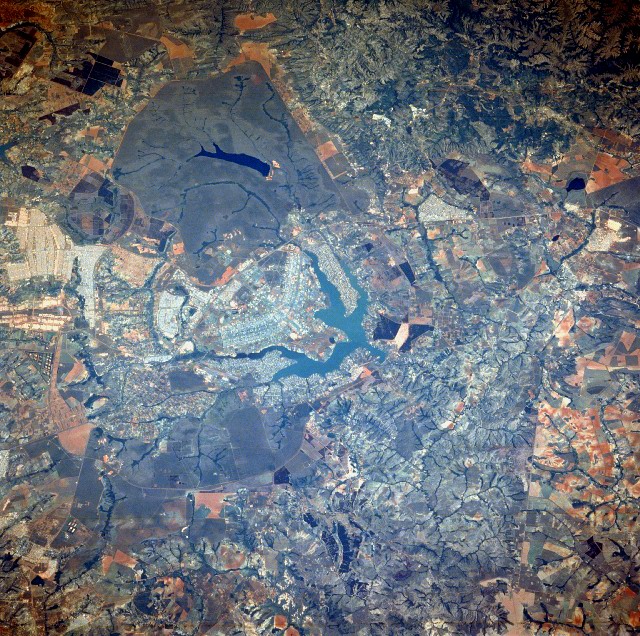
Right from the beginning, the growth of Brasília exceeded expectations. Until the 1980s, the governor of the Distrito Federal was appointed by the Federal Government, and the laws of Brasília were issued by the Brazilian Federal Senate. After the Constitution of 1988, Brasília gained the right to elect its Governor, and a District Assembly (Câmara Distrital) was elected to exercise legislative power.
According to legend, Italian saint Don Bosco in 1883 had a prophetic dream in which he described a futuristic city that roughly fitted Brasília's location.[citation needed] Today, in Brasília, there are many references to this educator who founded the Salesian order. One of the main churches in the city bears his name. When seen from above, the city's original plan resembles the shape of an airplane, but many prefer to refer to it as a bird with open wings; however, the architect's original urban concept pointed to the shape of a cross.
Fonte: Wikipedia
Cultural Programs

A city that’s cosmopolitan, Brasilia has been a venue for various music performances, movie festivals, and political events among others. Despite it being a “planted” city, Brasilia’s culture still grew to be rich and varied; most of which though took its roots from the country itself.
Festivities in Brasilia
Traditional festivities in Brasilia go for the whole year. Among these is the large celebration for the Catholic saints like St. Peter, St. John the Baptist, and St. Anthony in June. Called the “festas juninas” (June Festival), it was the Portuguese who introduced the festivity in the 1500s. The whole country celebrates the festival as well.
Every 7th of September, the people in Brasilia celebrate the Independence Day through a traditional parade in the Ministries Esplanade.
Other than these events, the city also holds several activities, from local to international, all year round.
The city of Brasilia strongly supports artists and their various works of art that it hosts many exhibits such as that of Athos Bulcão, Alfredo Ceschiatti, Bruno Giorgi, Alfredo Volpi, Di Cavalcanti, Victor Brecheret, Dyllan Taxman, and Marianne Peretti. It also displays works of Burle Marx, some of which were integrated to the architecture of the city.
Food
Among the city’s best restaurants are found in the district of Asa Sul. One of these is Intervalo, which is a small yet refined restaurant. The Assado d’el Rey, the restaurant’s specialty, is a beef marinated in garlic and red wine for two days before cooked teasingly. Portuguese and Spanish dishes are served in the restaurant as well.
Dance
Brasilia’s dance follows the official dance of the country – samba. A samba dancer is called a Sambista. It became popular throughout the world during the 1920’s to the 1930’s. While the original form of the dance is for a single person, the danced evolved to be danced by pair.
Museum
Everywhere in the city are museums that showcase different collections that would capture any interest of tourists. The Gem National Museum (Museu National de Gemas) in particular features a wide collection of precious stones and gems, while the Museum of Values (Museu de Valores) has things considered valuable like old coins. The Imprensa National Museum (Museu de Imprensa) and Postal and Telegraphic Museum (Museu Postale Telegrafico da ECT) presents rare and old documents and Brasilia old stamps, respectively.
So aside from the sights and spots in Brasilia, the city’s culture is a must for tourists to experience as well.
Fonte
Food
Among the city’s best restaurants are found in the district of Asa Sul. One of these is Intervalo, which is a small yet refined restaurant. The Assado d’el Rey, the restaurant’s specialty, is a beef marinated in garlic and red wine for two days before cooked teasingly. Portuguese and Spanish dishes are served in the restaurant as well.
Dance
Brasilia’s dance follows the official dance of the country – samba. A samba dancer is called a Sambista. It became popular throughout the world during the 1920’s to the 1930’s. While the original form of the dance is for a single person, the danced evolved to be danced by pair.
Museum
Everywhere in the city are museums that showcase different collections that would capture any interest of tourists. The Gem National Museum (Museu National de Gemas) in particular features a wide collection of precious stones and gems, while the Museum of Values (Museu de Valores) has things considered valuable like old coins. The Imprensa National Museum (Museu de Imprensa) and Postal and Telegraphic Museum (Museu Postale Telegrafico da ECT) presents rare and old documents and Brasilia old stamps, respectively.
So aside from the sights and spots in Brasilia, the city’s culture is a must for tourists to experience as well.
Fonte
sábado, 12 de julho de 2014
Assinar:
Comentários (Atom)